Impartial expert advice
to help you to choose the right Children's Furniture for your home
I've created a lot of furniture for children.
I've designed the most successful best-selling children's furniture for Harrods' Department Store.
I've designed children's furniture for some of the biggest global retail brands.
I've created furniture for international superstar singers and actors, and British nobility.
My furniture has been featured in countless glossy magazines across the world.
And my furniture has appeared on the usual bunch of TV home improvement shows in UK, US, and Australia.
blah, blah, blah................
In a nutshell: When it comes to children's furniture,..... I kind of know what I'm talking about. |

Before you go shopping....
I could tell you many horror stories about furniture delivery: from dismantling doorways and windows, delivery by crane through bedroom windows, removing radiators and doors, or the furniture being too high for the ceiling (this is scarily common).
Avoiding these problems is easy, just prepare:
Make a quick map of the bedroom
Take measurements of the room length, width and height.
Note where the positions of windows and doors (cupboard, fireplace, sink, jacuzzi, etc).
Measure the access
A common embarrassment is that the furniture won't fit through the door.
So remember to measure the access through the house: the size of the elevator, the width and height of the front door, the width of your stairs, any corners and turns into rooms or corridors, and the bedroom door itself. It is not unheard of to deliver furniture through a window, however this not recommended
without the assistance of the local fire-brigade, helicopter, or anti-gravitation device
Know what you need
Interior design is not just about what looks nice, it must work as practical furniture. So have an idea of how much storage space you need to allow for, do you need hang-space in the wardrobe or prefer shelve; what size of dresser you need and what additional functions you would like, (space for a TV, or computer, a sleep-over pull-out bed, a throne, home-cinema, or plinth for the butler).
Be Prepared
Now you are armed with this basic but vital information, go shopping.
Take your own tape measure, a notebook, comfortable shoes (and someone else's money).
about the self-appointed expert Brian Bailie MCSD
|
|
Choosing the right Bed
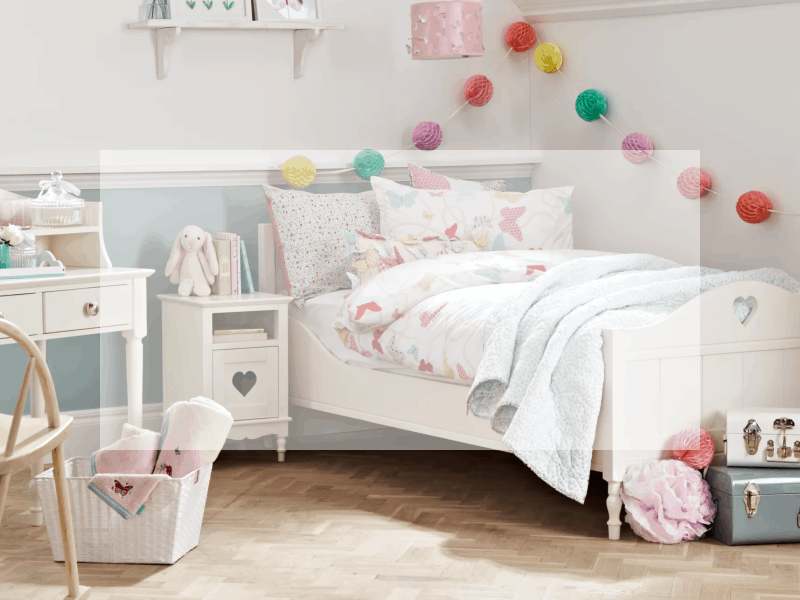
If this is a first bed I'm guessing that your child is about two years old, so you have the option of purchasing a small starter bed. This will have the same mattress size as a standard baby-bed of 1400 x 700mm. The advantage of buying a bed this size is that it leaves lots of floor-space in the room, and an average child [what is an average child?] will be able to use a bed this size until the age of seven or eight. (Another advantage of this size bed is that the mattress is readily available in sprung format with a wipe-clean body and breathable foam head area; this means that those tiresome bed-wetting days while junior gets used to getting out of bed to pee are not such a burden for cleaning up.)
Ordinary beds have a choice of mattress sizes. The standard mattress is [in the
UK] 1910 x 900mm. A Twin mattress size [preferred by Americans] is 990 x 1930mm. European and Baltic countries also have their own standard sizes, so remember this (if your an IKEA shopper).
The benefit of the larger bed is that your child can have a friend to sleep-over and simply share the bed. The other option is a trundle-bed or pull-out bed which is stored below the bed. It all depends on the size of room you have to work with.
Hardware
Beds come in many shapes and forms. When you find one you like, take a closer look. A child's bed will be a sofa, a trampoline, a den and, occasionally a place to sleep, it will take more abuse than any other bed in your house so check out the materials, and double check the hardware that holds it all together. Get onto the bed and sway left-to-right and up-and-down; give it a bit of a bounce; now pull back the mattress and keep an eye on the corner connectors while you push and pull on the joint. If there is movement when the bed is new, you can bet that it won't get any tighter with age; there should be no unacceptable movement, no creaking or cracking. The best bed connectors I have found are the Australian Maxi-Lock bed connectors which key together and tighten up with a threaded bolt. Most UK beds still use the traditional ‘hockey-stick' type connector which are okay if they are fitted correctly. Regardless of the type of fitting, check it for strength and slackness.
Mattress Foundation
There are two main types of foundations:
The Box Spring bed utilises a sturdy upholstered wooden frame containing springs or some other form of torsion. The box-spring serves three main purposes: To help raise the mattress's height; to help absorb shock and reduce wear to the mattress; and to help create a perfectly flat and firm structure for the mattress to lay upon.
Wood Slats are common, and these usually consist of at least a dozen solid wood planks strung together and fixed to the bed-rails. The slats should have soft edges, not machined to a sharp corner edge, or they will damage the mattress. They should be of good knot-free timber and preferably no more than 50mm apart. The main benefit of using a slatted bed is that you have much better access to below the bed for storage, retrieval and cleaning. And it allows the space for the pull-out trundle-bed.
Theme beds, such as car-beds, train-beds, digger-beds, fairy-tale designs, etc. Pay particular attention to these beds. These bed designs cost more to manufacture, so it is not unusual to discover that the manufacturer has attempted to save a little money by compromising the quality, which may affect stability and the serviceable lifetime of the bed.

Buying a bed online is made really easy nowadays, but there is nothing to beat going to a shop and handling, kicking, lying on the bed to check it over before you part with your money. If you buy online be sure that you have the option of a full refund for ANY reason; and that refund should include pick-up from your home. Most retailers will demand that the goods are returned in original condition and that the original packaging is used, so if in doubt, hang on to the packaging when you first receive the goods.
about the self-appointed expert Brian Bailie MCSD |
|
|
|
Choosing Baby's first bed
Crib, or Moses Basket
You might decide that a cot is too big and daunting for a newborn. They often sleep better in a smaller crib or a Moses basket which has the advantage of being portable so baby can nap wherever you are. It is generally advisable to keep baby in the same room as mother for their first six months, so choose a crib that will fit in with your own room
There are many designs to choose from. Basic checks are for stability on their frames, check that there are no rough edges, and check for factory odours. Don't feel that a crib is a necessity; another option is to buy a pram with a detachable carry-cot. This old-fashioned styled pram doubles as a crib which has the benefit of being on wheels so that baby can be rocked or swayed, or taken for a walk in it.
Baby-Bed or Cot Bed
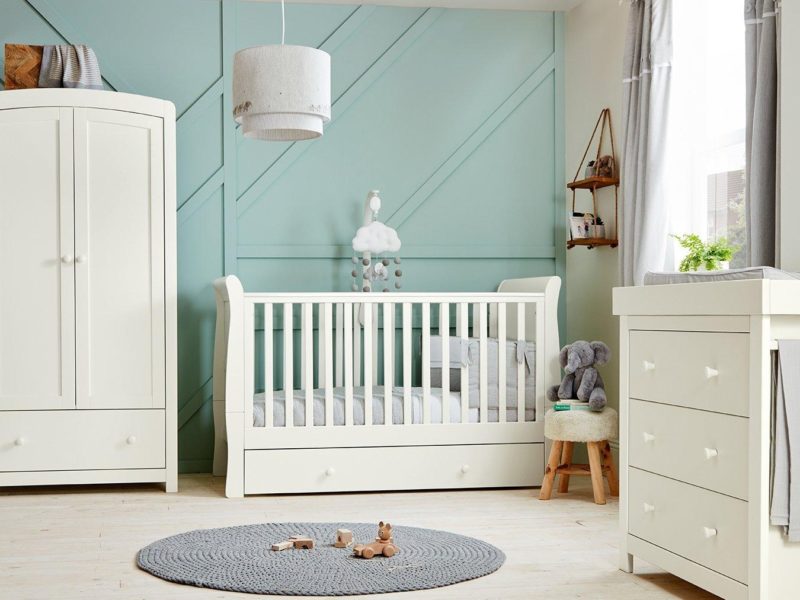
Again, it is generally advised that baby sleeps in the same room as mother for their first six months, so choose a baby-bed that will also work in your own bedroom.
Although I have designed and manufactured many baby-beds, I have to admit that (despite frustrated efforts) none of my children would ever sleep in one. However [having been foster-father to several other babies] I do have practical experience of good and bad models.
A baby-bed is a piece of furniture that you will only use for perhaps two years, so before you go shopping there is no shame in asking around family and friends to borrow one. If you do borrow a baby-bed, purchase a new mattress, and give the body of the baby-bed a good scrub clean with approved disinfectant.
Baby-beds come in different designs. Despite the many designs and configurations remember that the principle purpose of this little bed is to keep baby safe while they sleep, (and while they should be asleep).
When a baby is very young and unable to sit up it is convenient for mother to be able to raise the level of the mattress so that stooping is minimised; most baby-beds have this multiple level feature so that when baby is able to stand and climb the mattress level can be fixed low enough to prevent climbing out. Check the levels which are offered and that they work for your height.
The side-rails often have the feature of sliding up and down. If you like this feature check that the mechanism is quiet and free-running, (the last thing you want is for this sliding action to waken baby out of a sleep with clicks, squeaks and shakes). (I am tall so personally do not like the sliding siderail feature, however I have never suffered child-birth or its after affects, so I don't know how much easier it is for a woman to lift a baby with the siderails up.)
Generally, when the baby needs lifted and is big enough to stand, then you don't need to stoop into the baby-bed to lift them.
Check if the siderails can be removed. If a siderail can be removed without compromising the stability of the baby-bed it gives you the option of pushing the baby-bed up against your own bed and at the same level, and this is particularly useful if you are breast-feeding during the night because baby is right beside you in a little extension of your own bed. There are designs of baby-beds which convert to starter beds and little sofas or toyboxes. If your choice of baby-bed has this choice of conversion check that each configuration is fit for purpose, don't rely on a nice picture in a brochure, ask the showroom to show you a converted model so that you can give it a once-over check.
A useful addition to the baby-bed is a protective cover for the top edge of the siderails. When baby is big enough to stand, this rail is often the right height for chewing, and although paints are tested for toxicity, it is better that baby chews on something soft and avoids damaging the furniture. Check that the gaps between the side-rail bars do not exceed 40mm; and give the finish a good sniff to check for paint and lacquer odours.
General safety advice for baby:
- always place your baby on their back to sleep
- avoid smoking in pregnancy, that includes dad to be
- don't let anyone smoke in the same room as your baby
- don't let your baby get too hot
- quilts, duvets, and pillows should not be used for babies under 12 months old, as they may overheat
- keep your baby's head uncovered
- if your baby is unwell in any way seek medical advice at once
- don't fall asleep with your baby on the sofa
- keep your baby's cot in your bedroom for the first 6 months
- do not share a bed with your baby if you or your partner smoke, have been drinking alcohol, taking drugs or are on medication which makes you drowsy or excessively tired
Location:
Never place the cot near a hot radiator, a sunny window, shelves, ledges, or appliances that exploring little hands can grab, nor beneath a wall-hanging frame (especially one with glass or a mirror).
about the self-appointed expert Brian Bailie MCSD |
|
|
|
How to Choose a Mattress, Duvet and Pillow
Mattresses come in several widely differing qualities, and two common types: coil-spring and, foam.
You are more likely to be offered a coil mattress. In UK the acceptable thickness for a mattress is 200mm, however for your child's bed you will be offered a choice of mattress from a measly 100mm thick. (By contrast the US market standard mattress thickness is a whopping 300mm.) Buying a cheap mattress is a false economy for two reasons: first, it just won't spread the weight and will put direct pressure on the bed slats that support it which could break, and; secondly, and most importantly, it will be uncomfortable for your child. They will not sleep well, and you are compromising the health your child's spine which can lead to long-term back problems in adulthood.

When you choose a mattress, things you will feel without knowing what they are, are: coil-count (the more coils, the more support it offers); the gauge [thickness of the wire] of the coil spring gives the mattress the firmness, (so a soft quality mattress will have coils of 1.63mm diameter wire, a firm mattress may have 1.93mm diameter wire coils). Ask is the mattress flippable; does it have good padding or ticking (this is the soft panel between your body and the springs), on good mattresses this padding is deep and very luxurious and has a soft pad on one side of the mattress, and a softer pad on the other side so that you can flip the mattress to enjoy your choice of luxury.
Foam mattresses have two basic types: Latex, or polyurethane. These mattresses can be wonderfully comfortable and warm. Often the foam is laminated one layer of firmness over another so that the mattress is not simply a big sponge, but delivers a good core foundation of support with a softer top layer.
Check for allergies related to latex before using one for your child.
The newest Waterbed designs are built to look like the familiar mattress/foundation, with a water-filled core providing the support and layers of upholstery for insulation and surface comfort. Quality construction is especially critical when water is involved, so look for assurance that the vinyl and seaming are designed for maximum durability.
Upholstery layers
Upholstery layers cover the mattress and provide cushioning and comfort. Some manufacturers call the mattress core the "support layer" and the upholstery layer the "comfort layer." The upholstery layer consists of three parts: the insulator, the middle upholstery, and the quilt.
The insulator separates the mattress core from the middle upholstery. It is usually made of fibre or mesh and is intended to keep the middle upholstery in place.
The middle upholstery comprises all the material between the insulator and the quilt. It is usually made from materials which are intended to provide comfort to the sleeper, including regular foam, viscoelastic foam, felt, polyester fibres, cotton fibres, convoluted (“egg-crate”) foam, and non-woven fibre pads.
The quilt is the top layer of the mattress. Made of light foam or fibres stitched to the underside of the ticking, it provides a soft surface texture to the mattress and can be found in varying degrees of firmness. The protective fabric cover which encases the mattress is called ticking. It is usually made to match the foundation and comes in a wide variety of colours and styles. Most ticking is made of synthetic fibres like polyester, or acrylic; or of natural materials such as latex, cotton, silk, and wool.
Mattress Protector
A mattress protector is an item of removable bedding that sits on top of or encases a mattress to provide protection to the mattress. Some mattress protectors also provide protection to the individual sleeping on the mattress from allergens and irritants such as dust mites, bed bugs, mould, and dead skin (like dandruff).
Although a mattress can be vacuumed, it is very difficult to clean one thoroughly once it has become marked. An unprotected mattress can become marked or stained quite quickly as natural perspiration produced throughout the night passes through a standard fitted sheet and creates a telltale yellowish brown tidemark where it has been absorbed into the upper surface of the mattress. Mattresses are also susceptible to many other contaminants, in the case of children theses are commonly urine and vomit.
A mattress protector should be used if the child is known to be susceptible to allergies. A typical mattress can be home to millions of tiny dust mites. These creatures produce waste products that can irritate the lining of the airways and lungs and particularly with children can bring on allergic reactions, asthma and can irritate skin conditions such as eczema.
Not all mattress protectors are waterproof, some are designed to provide 'wear and tear' protection for the mattress and are available in the form of a lightly quilted fitted sheet. These will only provide minimal protection against liquids and little or no protection from dust mites. Waterproof and breathable mattress protects can provide protection against many allergens, however, as well as keeping the mattress clean by securing it from absorbing body excretions (such as sweat) or other liquids resulting from spills. For protection against bed bugs, the mattress and the box spring must be fully enclosed with no possibly opening
Duvet
Nowadays, a duvet is sometimes filled with silk, wool, or artificial fibres (such as polyester batting or other artificial material). It is sometimes confused with a comforter, although comforters go on top of the traditional sheets and blankets and are primarily decorative while duvets are used alone.
Tog ratings and temperature: Check the tog rating on the duvet and remember the higher the rating the greater the warmth. For a good safe night's sleep, babies need to be warm but not too hot. A steady room temperature for your sleeping baby and child is 16-20ºC. Buy a room thermometer to keep an eye on the temperature and check if your baby is sweating or feels hot to the touch to see if you need to adjust clothing or bedding.

Pillows
Just as the bed should provide good support for the child, the pillow should give the right cushioning to position the head and neck. It should hold your child's head in the same relation to their shoulders and spine as if they were standing with correct upright posture. If your child sleeps on their side, you may want a fairly firm pillow to give their head and neck extra support. If they sleep on their back, try a medium-firm pillow to cradle their head with more give. And if your child sleeps on their stomach (although some physicians caution against this position), choose a soft pillow to lessen the strain to the neck.
Internally, a pillow comprises a filler made from foam, synthetic fills,, silk fibre, feathers, or down. There are many varieties of hypoallergenic varieties of pillow. The pillow slip encases the filler with a cover made of cloth or silk. Even with regular washing, pillows tend to accumulate large amounts of dust and vast numbers of microbes among the fill and it is recommended that they be replaced every few years, especially for children with allergies.
about the self-appointed expert Brian Bailie MCSD
|
|
|
|
How to choose a Wardrobe or Dresser
Storage
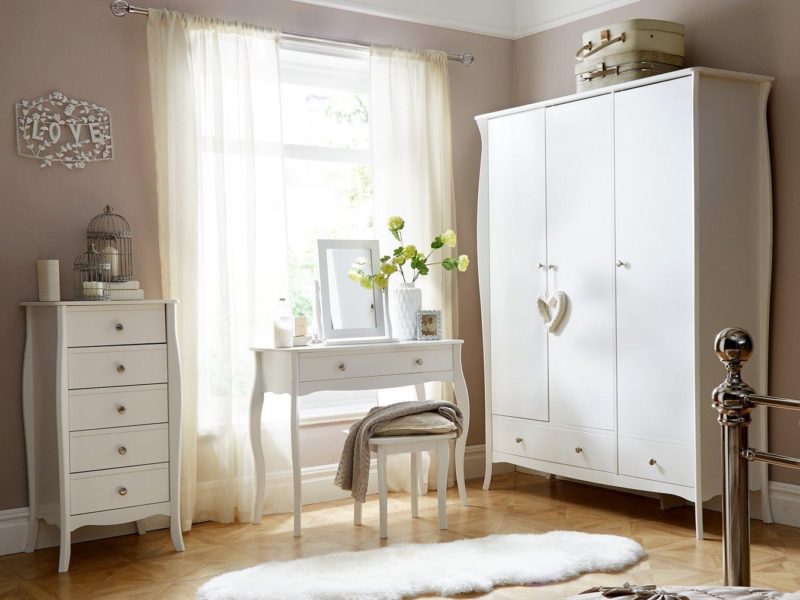
The primary function of this furniture is storage, so before you choose a style or design that you like, check that the storage facilities meets your needs.
 
Materials
Regardless of what it looks like, knock the doors with your knuckles to check they are sound and solid; is the back panel flimsy [the back panel is the section that supports the furniture against side-ways movement]; do the gables feel weak; do the drawer-boxes feel strong enough to support the use you need to give them?
 
Build
Is the cabinet Knock-Down or Self-Assembly construction? If it is K-D pay particular attention to the K-D hardware. If the hardware is cheap, regardless of how much quality is put into the rest of the cabinet, it is only as strong as it's weakest component, and unsuitable K-D fittings mean that the cabinet is unsuitable for everyday use.
The showroom should have a bedroom display for you to test, so give the furniture a good shake; lean it to one side, and then the other. There should be minimal movement.
The problem with K-D furniture is not when it is built and set in position; the problem comes a few months later when the furniture is pushed, pulled carried and dragged into another position. It is not uncommon for the K-D furniture to fall apart (ask any furniture removals expert).
The compromise with K-D furniture is of course the price. It is much cheaper to ship because it takes up much less shipping space, and if it is assembled with good quality K-D fittings together with wood-glue, it can be an excellent buy. However, in my experience, K-D fittings and chipboard do not a good cabinet make, so check that the core material of the cabinet is solid enough to carry the stresses which K-D fixtures will create. (Chipboard K-D furniture works in the kitchen because kitchen cabinets are fixed in place and secured to worktops and walls, but free-standing furniture must be strong against movement.)
Hardware
You don't naturally see the hardware, but if the hardware is cheap and unsuitable for its purpose it makes the cabinet worthless.
Hinges
Modern hinges [like the typical kitchen cupboard hinge] allow for adjustment up-down, left-right, and in-out. Most modern hinges are also self-closing so you don't need door catches or locks. However the modern hinge is made up of several components, so check the hinge for quality; check that there is no slackness in it, that it opens as it should and closes properly.
Butt hinges [like the typical house door hinge] have no adjustment, they have no self-closing option, so they must be used in conjunction with a lock or door catch.

I prefer the use of the modern self-closing hinges for the simple fact that, if a child climbs into a cupboard they can easily get out again; a door with a latch or lock can trap a child in a cupboard, and although maybe not life-threatening it can be very frightening for them. So if your cabinet has catches on the doors check that the doors can be easily opened from inside. (I remember explaining this feature to an Asian factory once, and they all looked at me as if to ask why Westerners keep their children in cupboards?)
Drawers may run on wooden rails or use modern drawer glides. The benefit of the modern drawer glide is that they don't fall out if they are pulled too far. Drawer glides come in two basic formats: single extension and, full extension. The full extension allows the drawer-box to open out fully exposing the entire drawer. Single extension only allows for most of the drawer to be exposed. Having said this, a single extension drawer glide offers more stability to a dresser by lessening the danger of a child opening too many drawers and having the cabinet topple over, (I have seen this happen; I have seen a child being eaten by a wardrobe: the child opened the wardrobe drawer and doors and then stood in the drawer to see better; the cabinet toppled and swallowed him whole. How he screamed). Toppling over is a risk that can be minimised by the use of wall-ties. These wall-ties can be improvised, or purchased at a DIY store. They simply fit to the top rear of the cabinet and are screwed tight to the wall.
Handles should be fitted with a threaded machine screw, not a wood-screw. If a child unscrews a handle and exposes a sharp pointy screw you have a potential hazard. Check the tightness of the handle fitting; often a handle will be fitted with a threaded metal or plastic insert that accepts the machine screw. If the insert becomes loose the handle will fall off, and it is not so easy to repair or replace.
Shelf-Supports come in many varieties from barely satisfactory, to excellent. There are many excellent plastic types, and some rubbish metal types, but generally the metal ones are superior. The thing to check is that they are locked in place with the shelf – in other words, when the shelf sits on the support, the support cannot come lose. This is a useful feature in children's furniture because if a child manages to pull out a shelf-support, someone could get hurt. And are there enough shelf-supports to carry the shelf? Press on a shelf and see if it sags in the middle, or if there is a central shelf-support on the back panel.
Also check if the shelf-supports are adjustable or removable. Often a closet will offer the option of a hang-rail or shelves.
The Hang-Rail needs three checks: check that the hardware supporting the rail is strong enough for purpose and fitted to a suitably strong section of cabinet; check that the rail does not sag with moderate weight; and check the ends of the removed rail for sharp or rough edges.
As I said before, children do not use furniture for the purpose intended, bedrooms are playgrounds and furniture becomes toys; the wardrobe will become a tree-house and the hang-rail will be used for swinging off, and dismantled to use as a sword.
Door and Drawer Bumpers are a nice feature that protect the furniture from slamming shut. They are a soft button of plastic that is applied to the back of a door or drawer. Check that these bumpers are well fixed and cannot be peeled off and swallowed by your mother-in-law.
about the self-appointed expert Brian Bailie MCSD
|
|
|
|
How to choose a Toy Box
Toy Boxes come in many shapes and sizes. However, toys come in even more shapes and sizes, and if your toybox is a simple open box you will soon realise that all the smaller toys become lost below the big ones. Either have a box for each size of toy, or buy one with separate compartments for storage.

Toyboxes will, by their purpose, suffer more abuse than most other furniture, so check it for build quality and check the finish for knock-resistance [by gently pressing your fingernail into the surface].

If it has a lid, check the hardware is fit for purpose. If the lid is hinged, is there a risk of the lid nipping fingers? And there should be a lid support which has a nip-free action and fully supports the weight of the lid so that the lid requires some effort to push it down closed.

Children may use the toybox to climb into, so check that a child cannot become locked in or trapped.
about the self-appointed expert Brian Bailie MCSD |
|
What is your furniture made from?
Solid Wood
Solid Wood furniture may be the natural first choice for quality furniture, however it is not always the most practical choice.

Solid wood moves; it widens when it is exposed to moisture, and shrinks when it is dried. Today's modern insulated, double-glazed and centrally heated home can have a detrimental effect on solid timber furniture if the timbers are not completely dried. The industry standard for furniture timber is under 12% moisture content. This if fine if the furniture has been in an equally dry atmosphere through its production and finishing, storage, shipping, warehousing and delivery. Be aware that wide solid wood panels and thick leg-post and bed-posts may shrink, crack and split, and always insist that the retailer guarantees refund or replacement in the case of timber flaws and allow for several weeks for the solid timbers to settle into your home environment. General rule of thumb is that the softer the timber, the more it is likely to swell, (so for example, pine will move more than ash, etc).
Veneers
These sound cheap and nasty, but in reality you are enjoying the beauty of timber grain without exploiting timber resources. You can own a mahogany headboard which only has mahogany on the top 3mm of the surface, (after all, unless you are going to start chopping into it you will never really appreciate the other 22mm beneath the surface anyway).
Veneers offer much more than a simple saving in natural timber resources by the fact that you only require such a small amount of solid timber to enjoy the natural timber grain, you also have a wonderful choice of fine and very beautiful timber veneers, many of which would not be stable enough to use in a solid format (for example the amazing burr walnut grain is very unstable unless supported as a veneer on a stable panel).
Always check what the core material below the veneer is. It may be a cheaper timber such as a pine, or a plywood, or MDF, or a chipboard.
Laminates and Wood-Based Panels
These are the core of your furniture, and dictate how stable and durable your furniture is regardless of how beautiful it may appear from a distance.
There are a few basic types: Plywoods; block-boards, and; wood-based fibre-boards.
Plywood can be excellent material. Cabinet gables, doors, drawer boxes, shelves; its stability and rigidity are generally superior to wood-fibre based board materials (which have a tendency to sag when used as shelves).
Block-Board is a construction of cheap timber lengths bonded into a panel and faced front and back with a veneer. Despite how this sounds, it creates a stable panel suitable for many furniture applications, and is superior in stability to wood-fibre based board materials.
ChipBoard is what it says it is, a board make from wood-chips. It is one of the most common board materials used in furniture construction, and generally speaking it is perfectly okay for light use. It must be veneered and edged to make it acceptable for furniture use, and often [in kitchen and children's furniture applications] is faced with hard-wearing melamine.
MDF, Medium Density Fibreboard is a material made from bonded wood-dust. It has become very common in children's furniture. It offers excellent stability, durability and strength, and can be finished with a veneer or painted with excellent results.
The primary concern with MDF is the make-up of the material, which is wood-dust bonded with a urea-formaldehyde resin. However, very dangerous as this resin is, the risk is only present during manufacture when the material is machined and the dust is created. Once the MDF is encapsulated with paint or lacquers the risk of dust is no longer present.
Plastic Furniture
Plastics is whole other world. There are thousands of different plastic compositions so to be brief, in a nutshell, here is my personal synopsis, and please research this further for yourself.
Plastic is a wonderful material that lets the designer explore new shapes that would be difficult or impossible with timber. It is light-weight, waterproof, knock-resistant and [depending on the particular plastic composition] can be very strong.
PVC, polyvinyl chloride contains numerous toxic chemicals which are used to soften the naturally brittle PVC into a more flexible material. Traces of these materials can leach out of PVC. The World Health Organisation has recognised the chemical used to make PVC as a known carcinogen, (the European Union has banned the use of the most widely used plasticiser [DEHP] in all children's toys.
Poly Carbonate plastics use the primary chemical building block Bisphenol A [BPA] which is a hormone disruptor that releases into food and moisture and acts like oestrogen. Research has identified this chemical with an increase in body weight of laboratory animals' offspring, as well as impacting hormone levels, and more recent research indicates that low-level exposure to BPA can result in insulin resistance which can lead to inflammation and heart disease.
In my nutshell: plastic furniture looks fantastic, is cheap and easy-clean, but unless you have all the facts would you really want to fill your child's room with the stuff?
On the other hand if you already buy your food in plastic wrappers, bring it home in plastic bags, keep it in a plastic-lined fridge and cook it in a plastic lined microwave oven, hey, why worry?
about the self-appointed expert Brian Bailie MCSD |
|
|
|
MDF is one of the most popular materials used to make children's furniture
How safe is MDF ?
Many people are concerned about the health risks involved in the use of Medium Density Fibreboard.
I was one of the first users of MDF in the UK before it became generally available and recognized for its versatility, stability and, finish. And I know what an unpleasant dust it is to work with. Not only is it an irritant to throat and nose, but the dust is incredibly powder-like and invasive. However once the work has been finished, either with paint it seems that MDF dust ceases to pose a risk.

WHAT IS MDF?
Wood based boards are used almost everywhere, there are three main types;
Laminated Board. Differing wood grain is used for each layer and is then
glued together giving the wood increased rigidity. Types of laminated wood
include plywood and blockboard.
Particle Boards: For example wood chipboard or flexboard. Here raw
material is processed to produce particles of varying size and is then
bonded with a resin binder.
Fibre Boards: Types of fibreboard are differentiated by the size and type
of wood fibres used, the method of drying, what type of bonding agent is
used and the method by which it is pressed into shape.
Medium Density Fibreboard is manufactured by a dry process at a lower
temperature than for example hardboard, another type of fibreboard. The
effect of this is that the natural glues and resins contained within the
wood are rendered ineffective. MDF therefore uses manufactured bonding
agents and resins. Varying density boards with differing finishes are used
for various end uses.
WHY BE CONCERNED ABOUT MDF?
In all fibreboards, formaldehyde resins are used to bond together the
constituent parts. This is usually urea formaldehyde, but some fibreboard
including exterior or marine quality board will use stronger glues such as
phenol formaldehyde.
Even at a low level, exposure to formaldehyde though inhalation can cause
irritation to the eyes, nose, throat and mucous membrane. Formaldehyde can
also affect the skin, leading to dermatitis, and the respiratory system
causing asthma and rhinitis. The International Agency for Research on
Cancer (IARC), part of the World Health Organisation, quoted evidence that
even short term exposure to formaldehyde, at far below the legal limit
allowable in Britain, could cause irritation to the eyes, nose and throat.
The IARC's findings also stated that wood dust is a carcinogen' (cancer
causing) and that 'formaldehyde is probably carcinogenic to humans'. IARC
was also concerned about the reproductive hazards of formaldehyde'.
Formaldehyde is classified in the UK and throughout Europe as a Category 3
Carcinogen. This means it is a substance which "causes concern for humans
owing to possible carcinogenic effects but, in respect of which, available
information is not adequate for making a satisfactory assessment." This
puts formaldehyde on the GPMU list of potential carcinogens, meaning it
should be replaced where possible, and if not, subject to rigorous controls
that reduce exposure to the lowest possible level.
HAVE OTHER COUNTRIES BANNED THE USE OF MDF?
Rumours that MDF is banned in America and/or Australia are unfounded.
However the US limits formaldehyde emissions from MDF to 0.3ppm (parts per
million), and home owners in California were warned that their new home had
been built using MDF: which "contains a chemical known to cause cancer,
birth defects or other reproductive hazards". Australia has a tighter
exposure standard than Britain and warns its workers that formaldehyde is
'a probable carcinogen' and a sensitiser (i.e. it can cause allergic
reaction such as asthma).
In Germany the exposure limit is 0.lppm, and Norway and Hungary both have
lower exposure limits than Britain and list formaldehyde as an allergen and
probable carcinogen.
In the UK, the Health and Safety Commission's Advisory Committee on Toxic
Substances is now being asked to review the hazards of working with MDF.
WHAT CAN BE DONE TO REDUCE THE RISKS FROM MDF?
Formaldehyde is recognised by the Health and Safety Executive as a
hazardous substance and as such has been given a Maximum Exposure Limit
(MEL). The MEL for formaldehyde is 2ppm and at no time should this limit
be exceeded. The Control of Substances Hazardous to Health Regulations
(COSHH) 1994 states that an employer must try to get as far below a MEL as
is reasonably practicable.
The employer has a general duty to ensure the health, safety and welfare of
their employees. Under the Management of Health and Safety at Work
Regulations 1992 (Regulation 3), an employer is legally obliged to carry
out a risk assessment. This risk assessment should lead the employer to
introduce measures to eliminate or adequately reduce risks.
COSHH Regulation 6 further states that, no employer may carry on any work
liable to expose employees to substances hazardous to health, unless a
suitable and sufficient assessment of the risks created by that work, and
of the steps needed to comply with COSHH in respect of it, has been made.
If formaldehyde in MDF is being used, and cut or worked, at your workplace
your employer should first try to use a safer material. If there is no
alternative to using fibreboard then your employer should consider low
emission board. Some board manufacturers are advertising low formaldehyde
or zero formaldehyde emission boards made to the stringent German 'E1'
standard. This standard is currently being reviewed by the European Union.
Where dust cannot be eliminated, the employer has to introduce control
measures which will adequately reduce dust levels. This will require
adequate ventilation. The most effective control measure is Local Exhaust
Ventilation. The exhaust mechanism is normally attached to the workstation
where board is being cut. As wood fibres are released from the board the
exhaust should remove them from workplace air. This ensures that most of
the dust is removed from the atmosphere as board is worked. Your employer
should also keep the workplace clean and ensure that the workplace is free
of any dust. Gloves should be provided to avoid formaldehyde coming into
contact with the skin, and suitable masks should be provided to avoid
inhalation or ingestion of fibres.
The Health and Safety Executive (HSE) has announced the publication of a Hazard Assessment Document for medium density fibreboard (MDF). The publication of this document follows on from an announcement in October 1997 that HSE would be reviewing the health effects of exposures arising from machining MDF. As part of the review HSE carried out a hazard assessment and commissioned an exposure survey and research into the characteristics of MDF dust/exposures. MDF is a wood composite material, primarily softwood, bonded with a synthetic resin, which is usually formaldehyde-based. It is used industrially in furniture and cabinet making. The atmosphere typically created by machining MDF contains a mixture of softwood dust (and hardwood dust if hardwood is present in the MDF), free formaldehyde, dust particles onto which formaldehyde is adsorbed and, potentially, the resin binder itself and its derivatives. The Hazard Assessment Document for MDF reports on the scientific evidence for the possible health effects of exposures arising from machining MDF and includes information from the HSE commissioned research on the atmosphere created during the machining of MDF. This is the first of a series of Hazard Assessment Documents that will be published by HSE. The health effects of constituents of MDF are: · Formaldehyde can cause irritation of the eyes, nose and throat. In experimental studies in rats, formaldehyde causes nasal cancer. However, there is no evidence that it has caused cancer, either nasal or other, in humans. · Some softwood and hardwood dusts can cause asthma.0ìmachining other forms of wood. There is some evidence for more frequent reporting of respiratory symptoms such as nasal obstruction in workers receiving exposures arising from machining MDF compared to other forms of wood or wood products. WATCH expressed the view that the most appropriate risk management strategy for MDF is the one currently recommended by HSE. This specifies that: · The level of dust arising from the machining of MDF should be kept to as low as reasonably practicable below the Maximum Exposure Limits (MELs) for softwood dust and hardwood dust. · Levels of free formaldehyde should be kept as low as reasonably practicable below the MELs for formaldehyde. Softwood and hardwood dusts each have an 8-hour time weighted average MEL of 5mg m-3 (total inhalable dust), whilst formaldehyde has MELs of 2 ppm, as an 8-hour time weighted average and as a 15-minute short term exposure limit. HSE is also preparing free guidance for publication next year aimed at those who use MDF at work. It will summarise the conclusions of the Hazard Assessment Document and the recently commissioned research and will provide a guide to working safely with MDF. Further Information Copies of the new publication, 'Medium Density Fibreboard - Hazard Assessment Document, EH75/1, ISBN 0 7176 1735 1, priced £7.50 are available from HSE Books, PO Box 1999, Sudbury, Suffolk CO10 2WA (tel 01787-881165 or fax 01787-313995).
about the self-appointed expert Brian Bailie MCSD |
|
What's your Child's furniture finished with?

Lacquer
Lacquer is a clear coat or stained varnish, (you can see the wood-grain through it), and is going to be one of three types in production furniture, either: nitro-cellulose; acrylic, or; water-based.
Nitro-cellulose is the most common lacquer in the furniture industry. This uses a solvent that evaporates during drying and curing leaving a hard finish.
The solvent carries the lacquer and changes the viscosity for spray-painting. If you smell a smell (often referred to as a 'new smell' by the retailer) when you open a new piece of furniture it will be the solvent. The furniture should be allowed to stand and air itself in a draught to remove this smell before it is placed in a child's room. Typically the furniture will have been finished many weeks earlier, but being boxed for transport encapsulates the smell until it is opened by the new owner.
Paint
Paint is widely used in children's furniture, particularly MDF furniture. The paint is typically composed of three main elements: the pigment; the binder, and; the solvent.
The pigment delivers the colour and opacity and this is where you might find the illegal use of lead pigments. Lead has been replaced with titanium dioxide, usually coated with silicon or aluminium oxides which equally enhance opacity and durability.
The binder is the resin that is the film-forming component of the paint. Binders include acrylics, polyurethane, polyesters, melamine resins, epoxy, or oils.
The solvent is used to carry the other components and used to adjust viscosity for application. As the solvent evaporates, the paint dries. In my experience the solvent evaporates in two stages: dry to touch, and smell away. When you open a new dresser or wardrobe and take a sniff it is the solvent you smell. This should be allowed to dissipate completely before exposing to a young child.
DIY store paint
It is more than likely that you will only have the facilities and equipment to use the paint and varnish selection offered by your local DIY.
Oil-based paints are freely available, and more common now are good water-based acrylics. It is unlikely that they will contain lead (unless you are buying from a dodgy source, or the tin is over thirty years old), but always check the label on the tin. Getting a good finish with these paints is difficult to achieve with a brush or little roller, and the only suggestion I have is to take your time, prepare well, and have somewhere to stand your painted components flat while they dry.
Wax
The best known wax is Beeswax. This is a good finish with a nice sheen. It is not heatproof, nor is it waterproof. And until the solvent, (which is usually turpentine, evaporates, it stinks something awful).
Oil is one of my favourite finishes. You can oil a piece of timber very quickly, and finish it ready to use almost immediately. A good blend of oil specifically created for furniture finishing is easy to apply and maintain. It is heatproof and waterproof. What I especially like about oil finish is that if the furniture gets a bash or a cut you can repair the wood and re-oil it easily without the need to re-finish a large area. The oil is soaked into the fabric of the timber and becomes a part of it, whereas other applications such as lacquer and paint sit on the top of the furniture and if damaged, repair is a major task.
Oil
If you are finishing a veneer or solid wood and want a natural finish, I recommend that you oil it. My favourite brand is Liberon who make an excellent Finishing Oil, or Rustin's who have an excellent blend of Danish Oil.
Varnish is freely available, however varnishing is a laborious exercise and unless you want a reflective finish, why bother?
However, only if you're prepared to follow instructions carefully, and only if you can get a good quality product, I highly recommend Pure Tung Oil, this stuff creates a beautiful waterproof finish (but if you get it wrong,... what a mess).
Leaving bare wood is the last option and not really recommended unless you want that very rustic, vernacular look. It will become stained with use, moisture will be absorbed and make it swell, and it may crack when it dries and contracts again, also leaving the risk of splinters, etc.
about the self-appointed expert Brian Bailie MCSD |
|
|
|
|